17 October 2026 · Updated 21 October 2026

Table of Contents
- What is Google Business Profile property developers need to understand?
- Key takeaways
- Why the map result affects initial discovery more than your website
- How to choose the right business category for a development
- What to write in your profile description
- Photos and virtual tours: what Google shows and what buyers trust
- Managing reviews when the buyer cycle runs to months
- Posts and updates: keeping the profile active through a long sales cycle
- Structured data on your website and how it connects to the profile
- Closing reflection
- Frequently asked questions
A show house in a new Centurion estate stands empty on a Saturday afternoon. The developer has printed brochures, taken drone photographs, and hired a show-day agent. Three kilometres away, a buyer searches "new developments in Centurion" on his phone. A competitor's development appears on the map with photos, a phone number, and eleven recent reviews from owners who moved in last quarter. The show house stays empty. The developer never built a profile.
What is Google Business Profile property developers need to understand?
A Google Business Profile is a free listing Google shows at the top of the page, above any website, when someone searches for a business or type of business nearby. For a property developer, it works like a sign at the gate: it tells buyers where you are, what you're selling and whether others found you worth their time.
Key takeaways
- A Google Business Profile is the single most visible thing a property developer can control in local search results, ahead of their own website.
- Buyers searching for new developments in a specific area see map results first; a developer without a profile can't appear there.
- The category, description, photos, and opening hours on your profile are ranking signals, not decorations: each one left incomplete is a gap your competitors fill.
- Reviews from buyers who have moved in are among the strongest trust signals a developer can accumulate before a show house visit.
- Posts on your profile keep it active and give Google a reason to show your listing over one that hasn't been touched in months.
- Property developer SEO begins with the profile, but the profile alone isn't enough without a website structured to support it.
Why the map result affects initial discovery more than your website
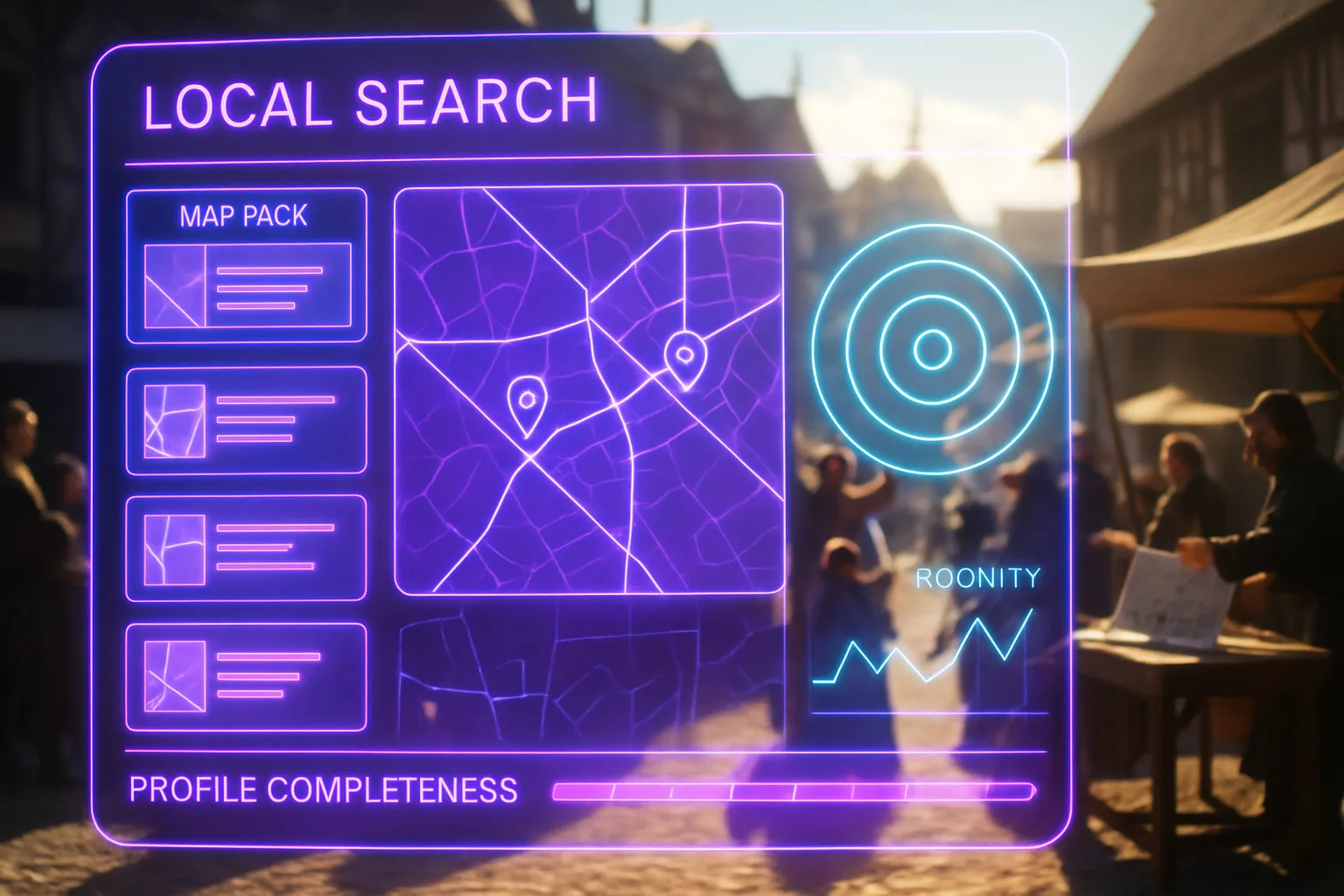
The first thing most buyers see when they search for a development in a specific area isn't a website. It is the local map pack: a set of three listings with a map, photos, a rating, and a tap-to-call button. Data on Google Business Profile performance shows more than 90 percent of people who find a business through a profile take an action shortly after, whether a call, a website visit, or a direction request.
For a property developer, this plays out in a specific way. A buyer researching off-plan developments in Fourways isn't typing a developer's name into Google. They are typing a suburb and a category: "new developments Fourways" or "apartments for sale Sandton". That search pulls a map. If your development doesn't have a claimed and completed profile, you aren't in the draw. The buyer has no reason to know your name, your website, or your show-house address. The profile is what puts you in front of them before they have heard of you.
How to choose the right business category for a development
Google's categories determine which searches trigger your listing, so choosing poorly here is the most consequential mistake a developer can make. The primary category should be as specific as your business allows. Options worth considering include "Real Estate Developer", "Property Developer", or "New Home Builder", depending on the nature of your projects. A developer listing as a generic "Real Estate Agency" loses the category signal telling Google who you are and which searches to show you for.
Google allows additional categories, and these are worth using accurately. A developer building a mixed-use project in Cape Town's Buitenkant Street corridor might select a primary category of "Real Estate Developer" and add "Apartment Building" or "Condominium Complex" as secondary categories. According to Google's Business Profile documentation, the category fields influence the searches in which your listing is eligible to appear, making them a ranking input, not a cosmetic choice. A developer building retirement villages and a developer building entry-level townhouses are competing for different buyers with different searches. The categories should reflect that difference precisely.
What to write in your profile description
The description field on a Google Business Profile is 750 characters. Most developers leave it blank or fill it with marketing language meaning nothing to the buyer and nothing to Google. Neither approach earns a ranking.
A useful description names the development type, the suburb or area, the price range if it reflects the market accurately, and the stage of the project. A buyer searching in a specific suburb wants to know within the first two lines whether your development is relevant to them. "Luxury two- and three-bedroom apartments in Umhlanga, priced from R2.4 million, with occupation in Q3 2026" is more useful than "a premium lifestyle development offering world-class finishes in a sought-after location". The first tells a buyer whether to call. The second tells them nothing.
Keep the description factual and specific. Include the primary suburb, the development type, and one distinguishing feature. Use the language a buyer would use, not the language a marketing department would approve. Guidance on local business structured data reinforces the same principle: the more specific and accurate the information on and around your listing, the more confidently Google can match it to the right search.
Photos and virtual tours: what Google shows and what buyers trust
A Google Business Profile without photographs is a listing buyers scroll past. For a property developer, photos aren't optional content. They are the primary trust signal a buyer uses to decide whether a development is worth a Saturday morning visit.
Google recommends a minimum of three photos for a business listing, but for a development where the buyer is making a decision worth millions of rands, that floor is too low. Upload a mix of exterior shots showing the streetscape and surrounds, interior shots of the show unit, photographs of common areas, and aerial images showing the development's proximity to landmarks. Label each photograph accurately in the file name before uploading, because Google reads that metadata.
The profile also supports a 360-degree virtual tour, which for an off-plan development is one of the most effective tools available. A buyer in Durban researching a Cape Town development can't drive to the show house on a weekday. A virtual tour on the profile gives them a reason to stay and a reason to call. According to real estate SEO research, listings with rich visual content generate significantly higher engagement than text-only listings. The buyer who has already walked through your show unit virtually is a warmer lead than one who has only read a spec sheet.
Comparison of profile completeness and buyer engagement factors for property developers
| Profile Element | Incomplete | Complete | Impact on Buyer Behaviour |
|---|---|---|---|
| Business category | Generic or missing | Specific to development type | Determines which searches trigger the listing |
| Description | Blank or vague | Suburb, type, price, timeline | Buyer decides relevance within two lines |
| Photos | Fewer than 5 | 15 or more, mixed types | Higher call and direction request rate |
| Reviews | None | 10 or more, recent | Credibility before the show-house visit |
| Posts | Never posted | Weekly or fortnightly | Signals an active, legitimate business |
| Opening hours | Missing | Accurate show-day hours | Reduces calls ending in no answer |
Managing reviews when the buyer cycle runs to months
A buyer purchasing off-plan property doesn't move quickly. The consideration period from first search to signed offer can be six months or longer. During that time, they check your profile repeatedly, and reviews are the social proof they rely on because they can't yet speak to a neighbour who lives in your development.
The challenge for a developer is timing. Most buyers are willing to leave a review, but only if asked at the right moment. The practical triggers are occupation day, the day the buyer collects their keys, and the first month after move-in, once the buyer has had time to form a real opinion. A WhatsApp message with a direct link to your profile's review page, sent the week after occupation, converts far better than a generic email six months later.
Responding to every review is worth the effort too. Google treats profile engagement as an activity signal. A developer responding to a one-star review about snag list delays, calmly and with a named contact to resolve the issue, demonstrates more credibility than one who ignores it. The buyer reading that exchange learns more about how the developer operates than any brochure could tell them. For context, profiles focused on apartment building management follow the same review engagement principle: responsiveness is visible, and buyers read it as a proxy for how the developer will treat them after handover.
Posts and updates: keeping the profile active through a long sales cycle
A development actively selling needs a profile signalling activity. Google uses recency as one of the inputs when deciding which listings to show for a given search, and a profile last updated in the month of registration looks, to both Google and the buyer, like a business that has stopped trading.
Posts on a Google Business Profile work like short announcements. For a developer, useful posts include launch announcements for a new phase, progress updates with photographs taken on site, sold-out notices creating urgency for the next phase, and event posts for show-day open days. A post about a show day in Waterfall, with a date, a time, and a photograph of the show unit, does two things: it gives Google fresh content to associate with your listing, and it gives a buyer who has already found your profile a specific reason to act this weekend rather than next month.
Newer posts push older ones down your profile, so aim for at least one per fortnight during an active selling period. This isn't content marketing in the full sense. It is profile maintenance, and it takes less than twenty minutes to do well. Property developer SEO ignoring the profile's activity layer leaves a ranking signal untouched.
Structured data on your website and how it connects to the profile
Your Google Business Profile and your website work together. A buyer who finds your profile and then clicks through to your website should land on a page confirming everything the profile promised: the suburb, the development name, the price range, and the stage of the project. Where many developers lose the buyer is in the gap between a well-maintained profile and a website telling them nothing new.
One technical addition strengthening this connection is structured data on your website. Structured data is a piece of hidden code labelling the information on your page so Google can read it as facts rather than guessing. It is like attaching a product label to a shelf. Instead of Google trying to determine from your page text you are a property developer in a specific suburb with a specific price range, the label states it directly. Google's documentation on local business structured data covers how to mark up a local business in a way complementing your profile. A developer's site using this markup correctly can earn a richer appearance in search results, including opening hours and contact details displayed before the buyer clicks anything. Google's guidance for web developers covers the technical foundations of making your site's content readable by search engines alongside your profile.
Closing reflection
A property development is one of the largest purchases a buyer will make. Most of them begin that decision with a Google search on their phone. Your profile is what they find before your website, before your show house, and before any referral reaches them. A complete, active, and well-reviewed profile isn't a marketing add-on. It is the front door of the sales process, and it is open or closed long before a buyer knows your name.
You shouldn't have to build a new development and then watch buyers walk into a competitor's show house because they found a better listing. With Zahavah Studio you won't.
Contact Zahavah Studio to get your Google Business Profile built, optimised, and connected to a website converting the buyers who find you.
There are questions arising consistently once a developer has claimed their profile and started seeing traffic. The answers below cover the ones worth knowing before you run into them.
Frequently asked questions
How do I verify my Google Business Profile as a property developer?
Verification is Google's way of confirming the business at the listed address is real and you are authorised to manage it. For a property developer, the most common verification method is a video call with a Google representative, during which you show the site or your office and confirm your identity. Google has also offered postcard verification for some business types, where a code is mailed to the listed address. The process typically takes a few days to a week. Until your profile is verified, it can be edited but won't appear in search results or on the map. If your development is off-plan and doesn't yet have a physical address, use your company's registered office address for verification and update the listing when the development address is confirmed. Google's Business Profile FAQ documentation covers verification pathways in detail. Completing verification promptly is worth prioritising because an unverified profile generates no search visibility regardless of how well it is filled out.
Should I create a separate Google Business Profile for each development or one profile for the company?
The practical answer depends on the scale and permanence of each development. A property company with an ongoing portfolio of developments in different suburbs benefits from a company-level profile tied to the business's registered office. A single large development with its own brand, show house, and marketing identity, one remaining active for two or more years, can support a standalone profile with the development's own address. Creating a profile for a development selling out in six months and then going dark isn't worth the effort, because a short-lived or inactive profile can attract negative signals over time. For most mid-size developers, one company profile, optimised for the suburbs and development types in the active pipeline, performs better than several thin, short-lived development profiles competing with each other. If you do create a standalone development profile, ensure the business name, phone number, and website URL match exactly what appears on your company-level profile to avoid conflicting signals that confuse Google's understanding of your business.
How many reviews does a Google Business Profile need to be competitive?
There is no official threshold Google publishes, but the pattern across local ranking factors research is consistent: profiles with ten or more recent reviews outperform profiles with fewer in competitive local searches. For a property developer, ten reviews is a realistic target for a development with fifty or more units, because each owner is a potential reviewer. The recency of reviews is as consequential as the count. Five reviews posted in the last month outperform thirty reviews from two years ago for a current search. Build the ask into your occupation process: a WhatsApp link to the review page, sent the week after a buyer moves in, generates responses at a far higher rate than an email sent months later when the buyer's enthusiasm has settled. A developer with twenty units handed over in the past six months has twenty potential reviewers. A structured follow-up message sent at the right moment converts a meaningful share of them.
Can I post show-day events directly on my Google Business Profile?
Yes. The Events post type on Google Business Profile is designed for time-bound announcements, and a show-day open day is exactly the right use. An event post requires a title, a start and end time, and a description. Add a photograph of the show unit and a call-to-action button linking to a booking form or your website's show-day page. Event posts appear in your profile's update feed and may appear in Google Search and Maps for searches relevant to your listing in the days before the event. They expire automatically after the end time, so they require no cleanup. A developer running fortnightly show days should post each one as an event the week before, which keeps the profile active and gives the listing a recency signal a profile with no posts doesn't have. If your show-day times change, update the event post rather than deleting it, so buyers who have already saved it receive the corrected details.
Does my Google Business Profile affect where my website ranks in ordinary search results?
Indirectly, yes. A Google Business Profile doesn't directly change where your website appears in the standard ranked list of search results below the map. However, the signals associated with your profile, including consistency of your business name, address, and phone number across the web, the volume and quality of your reviews, and the engagement your listing generates, are among the inputs Google uses to assess the authority and relevance of your business overall. A well-maintained profile, consistent with the information on your website, reinforces the credibility of both. The connection works the other way too: a website with structured data correctly marking up your business details strengthens the information Google associates with your profile. For property developer SEO in South Africa, treating the profile and the website as separate projects is a mistake. They support each other, and the buyer moves between them without noticing the difference.

Yvonne van Wyk
SEO Strategist · Zahavah Studio
Yvonne van Wyk runs Zahavah Studio, a Johannesburg SEO agency focused on long-term search visibility and AI citation. Her writing covers local SEO, content strategy, analytics, and the mechanics of how search works.
Everything on this blog is written to inform and educate. It is for information only. Nothing here is professional legal, financial, or technical advice. If you are making a significant business decision, speak to a qualified professional first. Zahavah Studio works hard to keep this content accurate and current, but is not liable for decisions made based on what you read here.