22 October 2026 · Updated 22 October 2026

Table of Contents
- What is multi-location SEO?
- Key Takeaways
- Why single-site SEO fails a franchise
- Location pages: the foundation of franchise SEO
- NAP consistency across every branch
- Google Business Profiles: one per branch, not one for the brand
- Avoiding cannibalisation between branches
- Managing franchise SEO at scale: head office versus branch level
- Closing reflection
- Frequently Asked Questions
A fast-food franchise owner in Germiston checks his phone on a Tuesday morning. His Boksburg branch is getting walk-ins. His Alberton branch, three kilometres away, isn't showing up in Google at all. Both locations are on the same website. Both pay the same monthly fee to the same head-office marketing supplier. He types "franchise near me" into Google himself and watches his Alberton branch fail to appear on the map. Same brand, same product, different result.
What is multi-location SEO?
Multi-location SEO is the practice of optimising each branch of a business so it ranks in local search results for its own area, while the brand as a whole keeps a consistent national presence. It means your Pretoria branch appears when someone in Pretoria searches, your Durban branch appears when someone in Durban searches, and neither branch competes with or obscures the other. One website, one brand, but each location earning its own visibility.
Key Takeaways
- Each franchise branch needs its own dedicated location page with a unique address, phone number, and local content.
- NAP consistency (the name, address, and phone number of each branch) must match exactly across Google, directories, and your own website.
- Every branch needs its own Google Business Profile connected to its specific location page, not the homepage.
- Duplicate content across location pages is the most common reason franchise sites underperform in local search.
- Multi-location brands running consistent local profiles achieve significantly stronger Google Business Profile engagement than brands with partial or inconsistent setups.
- Head-office control and local relevance must coexist: templates protect brand consistency, but local proof is what earns local rankings.
Why single-site SEO fails a franchise
Standard SEO treats a website as one entity with one location. Franchise groups aren't one entity. They're ten branches, or forty, each serving a different suburb, competing against different local rivals, and being searched for by different people. When a franchise tries to rank all its locations through a single homepage or a generic "find a branch" page, Google has no local signal to act on. It can't place the Centurion branch in Centurion's map pack if Centurion's address appears only in a dropdown menu nobody links to.
The distinction has practical consequences. Multi-location SEO treats each branch as a local business in its own right while keeping the brand architecture intact. A solo florist doesn't face this problem. A franchise group with twelve locations absolutely does. In practice, the work involves managing each location's signals separately, not treating the brand as a single search entity. Our guide to local SEO for multiple locations covers the mechanics. The franchise owner who assumes head-office marketing handles local visibility is usually the one wondering why the Alberton branch has gone quiet.
Location pages: the foundation of franchise SEO
Your franchise website needs a dedicated page for every branch: not a pin on a map, not a paragraph in a footer, and not a shared page listing five addresses in a table. A dedicated location page is a full webpage built for one branch: its address, its phone number, its trading hours, the specific services available at that branch, and content written to serve the people searching in that area.
The page structure has direct consequences because Google reads these pages to understand what a branch offers and where it operates. A page where the Sandton branch and the Rosebank branch share identical body text, differing only by suburb name swapped in two sentences, tells Google almost nothing useful. Google has seen that pattern before, and it doesn't reward it. Each page needs at least one element specific to that branch: a local landmark reference, a neighbourhood-relevant question the branch answers, or testimonials from customers in that area. This local proof is what separates a page Google shows from a page Google ignores.
Franchise groups in the restaurant and retail sectors have found branch-specific pages, built with unique local content, outperform generic location templates in local pack placements. One reason is straightforward: Google rewards the page giving the searcher the most useful, specific answer to their location-based query.
NAP consistency across every branch
NAP stands for name, address, and phone number. These three pieces of data are the basic coordinates Google and every other directory uses to verify a business is real and where it is. For a franchise group, NAP consistency means the Johannesburg North branch's details appear identically on your website, on Google, on Yelp, on Facebook, on Foursquare, and on every local directory where the branch is listed. Not approximately the same. Identically the same.
A mismatch as small as "Road" on one platform versus "Rd" on another creates a discrepancy Google notices. Google's guidance on local ranking asks businesses to keep their information complete and accurate, and a branch whose details disagree across the web gives Google a reason to doubt all of them. For a franchise with forty branches, that's forty sets of coordinates to audit and keep aligned. Head office often assumes the franchisee handles their own listings. The franchisee assumes head office handles it. The result is a patchwork of outdated addresses, old phone numbers from before a branch moved, and trading hours nobody has updated since the last ownership change.
The practical fix is a centralised NAP audit run across all branches before any other local SEO work begins. Every mismatch is corrected at the source, not papered over with a note.
NAP field comparison across a franchise's key platforms
| Platform | Branch name format | Address format | Phone format | Hours listed |
|---|---|---|---|---|
| Website location page | Full legal brand name | Street address with suburb | Local number | Yes |
| Google Business Profile | Full legal brand name | Identical to website | Identical to website | Yes |
| Facebook branch page | Full legal brand name | Identical to website | Identical to website | Yes |
| Local directory listing | Full legal brand name | Identical to website | Identical to website | Yes |
| Yell / Foursquare | Full legal brand name | Identical to website | Identical to website | Yes |
Google Business Profiles: one per branch, not one for the brand
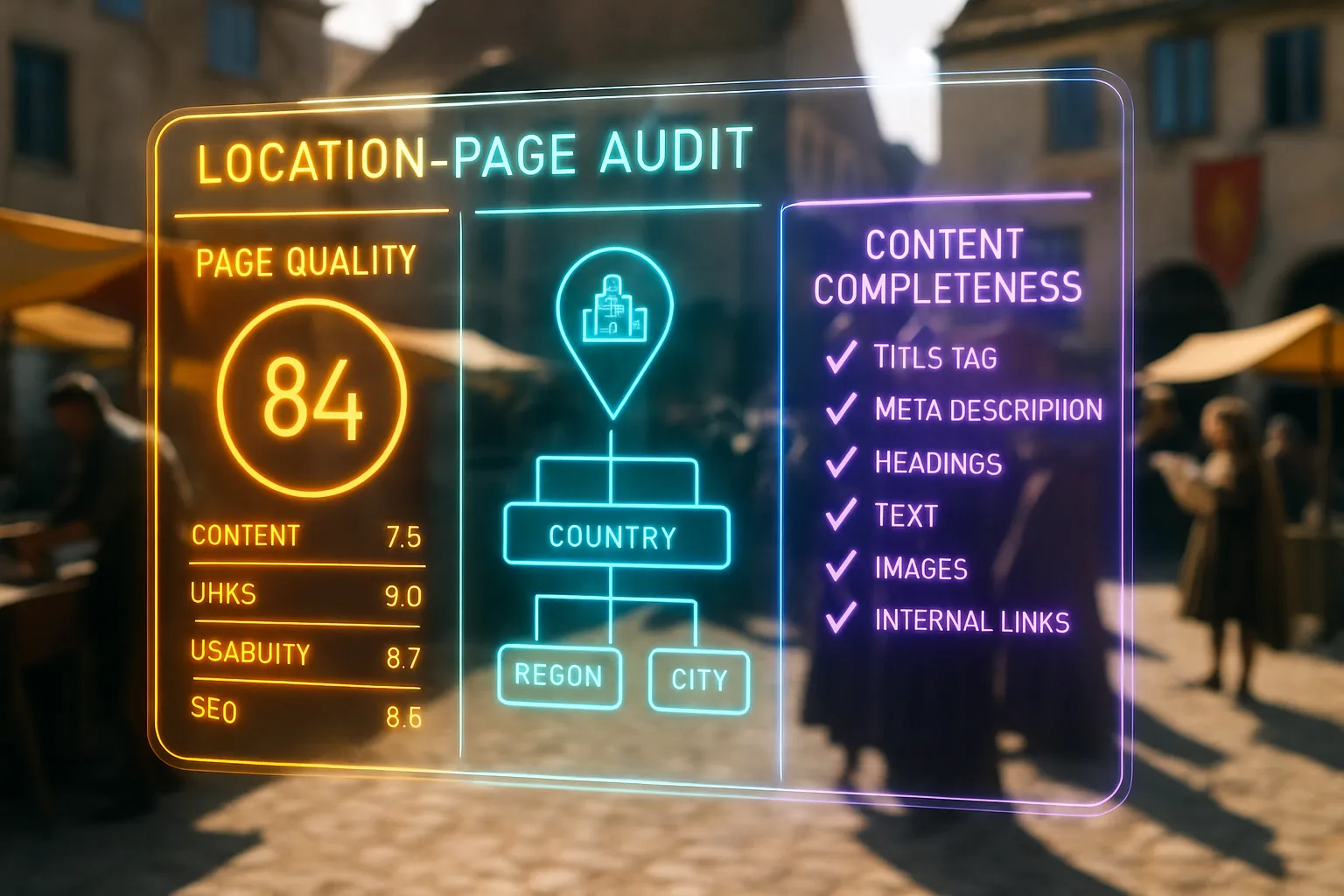
A Google Business Profile (GBP) is the listing appearing in Google Maps and in the box of results Google shows when someone searches for a business by name or type. It's the listing with the phone number, the star ratings, the photos, and the link to the website. For a franchise group, the instinct is to manage one central profile under the brand name. That instinct costs rankings.
Each branch needs its own GBP, verified to its own physical address, linked to its own location page on the website, and managed with its own set of photos, reviews, and trading hours. When the GBP for the Bellville branch points to the homepage rather than the Bellville location page, Google can't close the loop between the search query, the local result, and the landing page. The conversion (the phone call, the booking, the visit) is harder to earn because the page the searcher lands on isn't about Bellville at all.
Google's guidelines for representing your business ask for one profile per location, with the business shown consistently, the way it appears in the real world. For franchise groups, this applies with particular force: the signals across forty branches compound either in your favour or against you. Multi-location brands achieving strong GBP engagement don't stumble into it. They maintain branch-by-branch profile discipline as a standing operational task, not a once-off project.
Avoiding cannibalisation between branches
Cannibalisation happens when two of your own pages compete for the same search query. In franchise SEO, it appears when two nearby branches target identical keywords on identically structured pages. If your Midrand branch and your Centurion branch both target "tyre fitment centre near me" with the same page template and no geographic differentiation, Google must choose between them. It may rank neither, because neither signals a stronger claim to either suburb.
The fix is geographic specificity at every level. The Midrand page targets Midrand, Halfway House, and Vorna Valley. The Centurion page targets Centurion, Lyttelton, and Irene. Their H1 headings differ. Their meta titles differ. Their content refers to local streets, local events, or local customer names where franchisees have permission to use them. When the branch-level data is managed correctly, each branch competes for its own suburb, which is the differentiation doing its job. Cannibalisation is what happens when it isn't.
Each branch needs a clear, accurate identity so Google can do what it's trying to do: match the searcher in Midrand with the Midrand branch.
Managing franchise SEO at scale: head office versus branch level
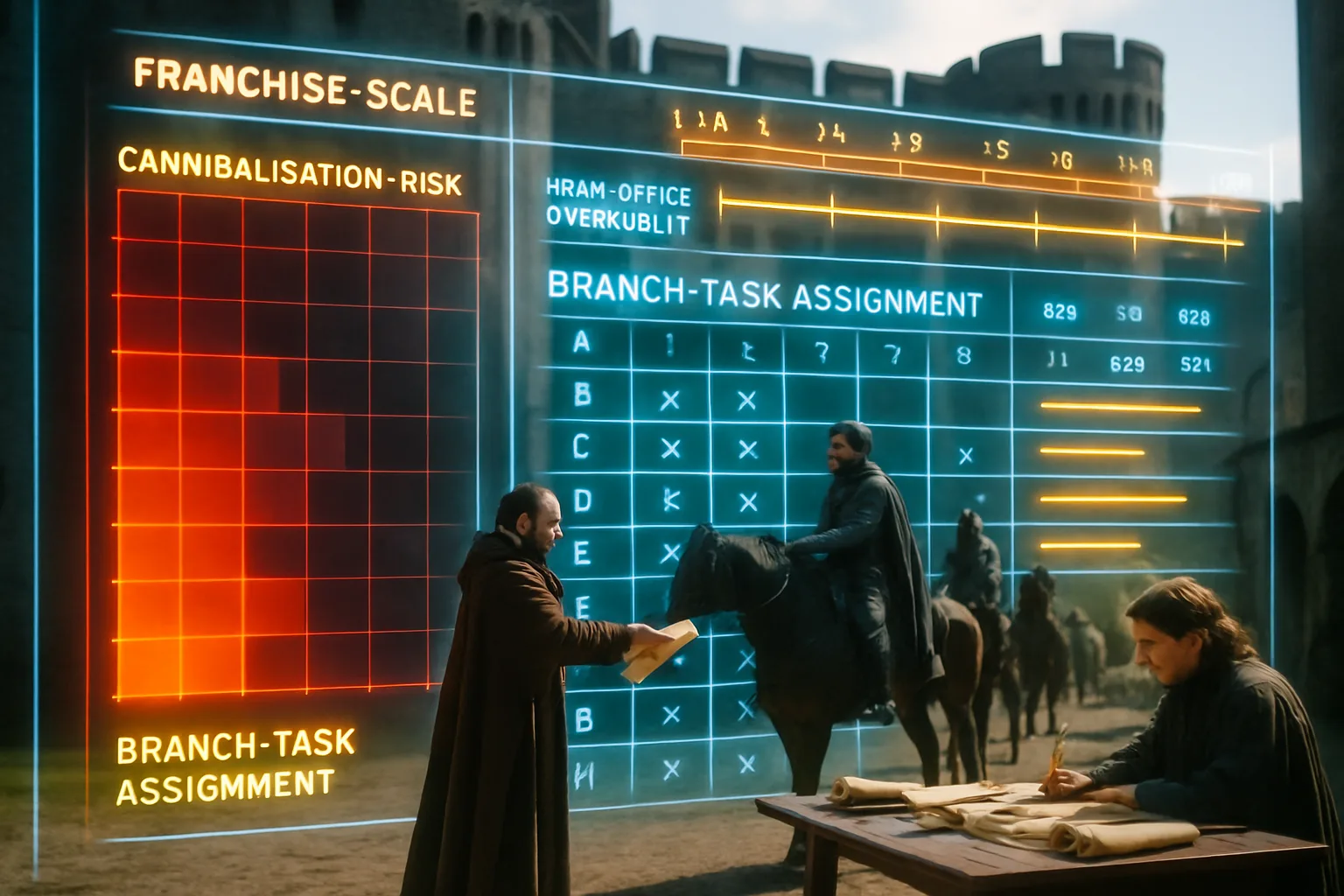
The question every franchise group eventually faces is where control sits. Head office wants brand consistency: the right logo, the right tone, the correct legal name on every listing. The franchisee wants local relevance: their own reviews, their own promotions, their own neighbourhood content. Multi-location SEO requires both, and the architecture delivering both is a template with local slots.
A template-with-slots approach gives head office control over the structure of every location page: the header, the navigation, the brand description, the schema markup (structured data code added to each page telling Google directly what business type it is, where it is, and how to reach it), while leaving specific fields open for local content. The franchisee, or a content manager at branch level, fills in the local trading hours, the local testimonials, and any branch-specific promotions. Head office audits those slots quarterly.
The same logic applies to GBP management. Head office holds admin access to every branch profile. Branch managers get contributor access to update photos and respond to reviews. Reviews responded to within 24 hours signal an active, managed listing. The arrangement that tends to work is branch-level GBP activity with head-office oversight of the core data.
Closing reflection
Running franchise SEO well isn't a marketing exercise. It's a data management exercise with a marketing outcome. Each branch is a local business with its own address, its own customers, and its own Google presence to build. The franchise group treating its branches as interchangeable pages on a shared website will keep watching its map pack appearances come and go without explanation. The group treating each branch as a local business, with its own page, its own profile, and its own local signals, builds something compounding over time.
You shouldn't have to watch half your branches disappear from local search while head office wonders why enquiries are uneven. With Zahavah Studio you won't.
Contact Zahavah Studio to audit your franchise's location pages, NAP consistency, and GBP structure across every branch.
The questions below address what most franchise operators and head-office marketing teams ask once they start looking at their multi-location SEO seriously.
Frequently Asked Questions
Does each branch need its own dedicated location page for multi-location SEO?
Yes, every branch needs its own dedicated location page: not a shared page listing multiple addresses, not a pin on a contact map, and not a paragraph in the footer. A dedicated location page is a full webpage built for one branch, with its own address, phone number, trading hours, services, and locally relevant content. Google uses this page to understand what a branch offers and where it operates. Without it, the branch has no organic signal for its own suburb. Managing each location's signals separately is the structural requirement for a business ranking in multiple regions. A homepage or a generic branch finder can't carry that signal. Build one page per branch, give each page unique local content, and connect it to the correct Google Business Profile. That connection is how Google closes the loop between a local search query and a specific branch result. Your branch finder page can list locations for navigation, but each branch still needs its own standalone page to earn local rankings.
Does each location page need the correct address and phone number for multi-location SEO to work?
Correct NAP data (the name, address, and phone number) is the baseline, not a bonus. Every location page must display the exact address and phone number of that branch, and those details must match identically across Google, every directory, and your own website. A mismatch as small as "Street" on one platform versus "St" on another creates a discrepancy Google factors into its trust assessment of the listing. Inconsistent details make it harder for Google to trust which version is right, and harder for a customer to reach the branch. For a franchise group with twenty or forty branches, auditing NAP across all platforms is the first practical task before any other local SEO work begins. It isn't glamorous. Agencies rarely lead with it. It is, however, the reason some branches rank and others don't despite identical effort on everything else. A quarterly audit schedule, owned by head office and checked against every live directory, keeps the data from drifting after staff changes or branch relocations.
Does each location page need to connect to the right Google Business Profile for multi-location SEO?
Each location page must connect to its own Google Business Profile, and each GBP must link back to its own location page: not to the homepage and not to a shared brand profile. The connection between the GBP and the location page is how Google verifies the branch is real, active, and in the right place. When a GBP points to the homepage, the searcher who clicks through lands on a page with no useful local information, and Google registers the disconnect. Each GBP needs to be verified to the branch's physical address, populated with branch-specific photos and trading hours, and linked to the correct location page. Head office should hold admin access to every branch profile so core data (business name, address, category) stays consistent. Branch managers can hold contributor access to handle photos and review responses. That division of responsibility keeps the profiles active without allowing the core data to drift. Reviews responded to within 24 hours further signal an active listing, which Google factors into local pack placement for your branch.
Does each location page need to reflect local services and local proof for multi-location SEO to rank?
Local proof is what separates a location page Google shows from one Google ignores. A page where every branch carries identical body text, with only the suburb name swapped, gives Google no reason to prefer it over a competitor's page written specifically for that area. Local proof includes customer testimonials from people in that suburb, references to local landmarks or streets near the branch, photos taken at that specific location, and any services or promotions specific to that branch. Well-maintained branch-level data gives each page something a generic template can't. The franchise groups getting this right aren't writing custom essays for every branch. They use a template with open slots for local content, and they fill those slots with real branch-specific information. Even a single locally grounded element, such as a named nearby street, a branch manager's first name, or a promotion tied to a local event, gives your page a foothold a generic template can't provide.

Yvonne van Wyk
SEO Strategist · Zahavah Studio
Yvonne van Wyk runs Zahavah Studio, a Johannesburg SEO agency focused on long-term search visibility and AI citation. Her writing covers local SEO, content strategy, analytics, and the mechanics of how search works.
Everything on this blog is written to inform and educate. It is for information only. Nothing here is professional legal, financial, or technical advice. If you are making a significant business decision, speak to a qualified professional first. Zahavah Studio works hard to keep this content accurate and current, but is not liable for decisions made based on what you read here.