1 October 2026


Table of Contents
- What is structured data for AI?
- Key takeaways
- Why AI answer engines need labelled content
- The schema types worth adding first
- How schema functions as a trust signal, not a ranking switch
- Where structured data sits in your GEO strategy
- Validating your schema and fixing common errors
- Closing reflection
- Frequently asked questions
A solicitor in Dublin searched for her own firm in Perplexity. Three competing firms appeared in the answer. Their names, their practice areas, and their founding dates were woven into the response as if the model had read a profile card. Her firm's website had more content, better reviews, and a longer history. The model hadn't cited her once. She had no idea her site was giving AI systems nothing clean to read.
What is structured data for AI?
Structured data for AI is a layer of hidden code added to your website's pages that labels what each piece of information is. Instead of leaving an AI system to guess whether a block of text is a business name, a service, a review, or an opening hour, the label tells it directly. Picture a filing label on every drawer in your cabinet: the model doesn't have to pull each drawer open and read the contents to know what's inside. It reads the label and moves on, faster and with more confidence.
Key takeaways
- Structured data uses a standardised code format to label your content so AI systems can read and cite it without guessing.
- Schema markup doesn't guarantee a citation, but it removes the friction stopping AI models from selecting your content as a source.
- The most useful schema types for AI citation are Organisation, Article, FAQPage, Product, and Review.
- AI systems prioritise content they can verify; schema gives them the verification signals they need quickly.
- Adding schema is a technical task but not a complex one, and the return compounds over time as AI search grows.
- The evidence on schema's direct impact on AI citations is mixed, but its role as a trust signal and entity clarifier remains consistent across platforms.
Why AI answer engines need labelled content

AI answer engines don't read your website the way a person does. They scan, parse, and extract. When a model like ChatGPT, Perplexity, or Google's AI Overviews composes an answer, it pulls from content it has already indexed and assessed for credibility. The pull happens in milliseconds, and the model favours content it can process without ambiguity.
Unlabelled content creates ambiguity. A paragraph describing your firm's founding year, headquarters city, and lead service could be read as a biography, a case study, or a product description. Without labels, the model has to infer. Inference introduces error, and models encountering error-risk tend to pass over that content in favour of something cleaner.
Schema markup, which follows the vocabulary defined at Schema.org, closes that gap. It wraps your content in a format telling the model: this is an organisation, this is its name, this is what it does, and these are the people behind it. A model composing an answer about law firms in Dublin can extract your details cleanly, verify them against what it already holds, and cite you with confidence. The Schema.org vocabulary covers hundreds of entity types, from local businesses and articles to products, events, and people.
The schema types worth adding first
Not every schema type carries equal weight for AI citation. The types worth prioritising are the ones establishing who you are and what you know.
Organisation schema identifies your business as a named entity: its legal name, founding date, address, contact details, and the services it provides. This is the foundation. An AI model composing a response about a category of business needs a clean entity record to cite, and Organisation schema gives it one.
Article and BlogPosting schema label your written content with an author, a publication date, and a topic. When a model is building an answer from multiple sources, it looks for signals showing the content was written by a real person with named credentials on a specific date. Undated, unattributed content looks thin to a model assessing credibility.
FAQPage schema is particularly effective. It marks up a question and a direct answer in a format AI systems recognise as answer-ready. A model composing a response to a query is, in effect, selecting the best pre-formed answer it can find. FAQPage schema puts your answer in front of it in exactly that shape.
Review and AggregateRating schema give AI systems a trust signal rooted in third-party opinion. A business with structured review data is harder to dismiss as self-promotional. The model can see others have assessed the product or service and recorded their view.
Google's own guidance on structured data compliance notes schema must follow the general structured data guidelines and validate correctly to be eligible for Search features. The same principle extends to AI-generated results: broken or non-compliant markup is ignored.
How schema functions as a trust signal, not a ranking switch

There is a temptation to treat schema as a lever: add it, pull it, and watch citations appear. The evidence doesn't support that framing. A study reviewed by Search Engine Journal found schema is far less a ranking switch than a trust builder, working as a tool distinguishing entities from similar ones, confirming claims, and qualifying pages for rich results and AI visibility alike.
The distinction is important for setting expectations. Schema doesn't instruct an AI to cite you. It removes the reasons an AI might not. A model choosing between two sources on the same topic will favour the source where authorship is confirmed, the entity is named, the content type is declared, and the facts align with what the model already holds. Schema provides those confirmations. Without them, your content competes on inference alone.
Evertune's analysis of schema versus no schema in AI search found structured data for entity relationships creates what amounts to a content knowledge graph, helping AI systems understand a brand's expertise and authority at scale. That's not a ranking mechanism. It's a credibility infrastructure accumulating over time.
A counter-point is worth naming. An Ahrefs study (summarised in their video on schema and AI citations) found no direct correlation between schema implementation and improved citation rates in LLM outputs. The SEO industry had theorised a neat causal chain the data didn't confirm. That's a useful corrective to the hype; it doesn't make schema irrelevant, but it does make the honest case for schema as a foundational signal rather than a citation guarantee.
Where structured data sits in your GEO strategy
GEO stands for Generative Engine Optimisation and describes the practice of making your content easier for AI systems to cite. It relies on several reinforcing signals. Schema is one of them, and understanding where it sits helps you avoid over-investing in markup while under-investing in the content quality feeding it.
A simplified view of how signals layer in a GEO strategy
| Signal | What it does | Where schema fits |
|---|---|---|
| Content quality | Gives AI a substantive answer to extract | Schema labels the content type and author |
| Entity clarity | Tells AI who you are | Organisation schema is the primary vehicle |
| Answer shape | Matches the format AI prefers | FAQPage and Article schema reinforce this |
| Trust signals | Confirms others have validated you | Review schema carries third-party evidence |
| Technical hygiene | Ensures AI can access the content | Schema must be valid and crawlable |
Schema threads through every layer. It doesn't replace strong content or a clean technical foundation, but it makes all of them easier for AI systems to process. A page with excellent content and no schema is like a well-written letter with no address on the envelope: the content is good, but delivery is uncertain.
Google's documentation on image license metadata offers a practical illustration of how schema extends beyond text: even images benefit from structured labelling, with fields telling search systems what the image depicts, who owns it, and under what terms it can be used. The principle is the same across all media types. Labels allow machines to act on content without having to interpret it first.
Validating your schema and fixing common errors
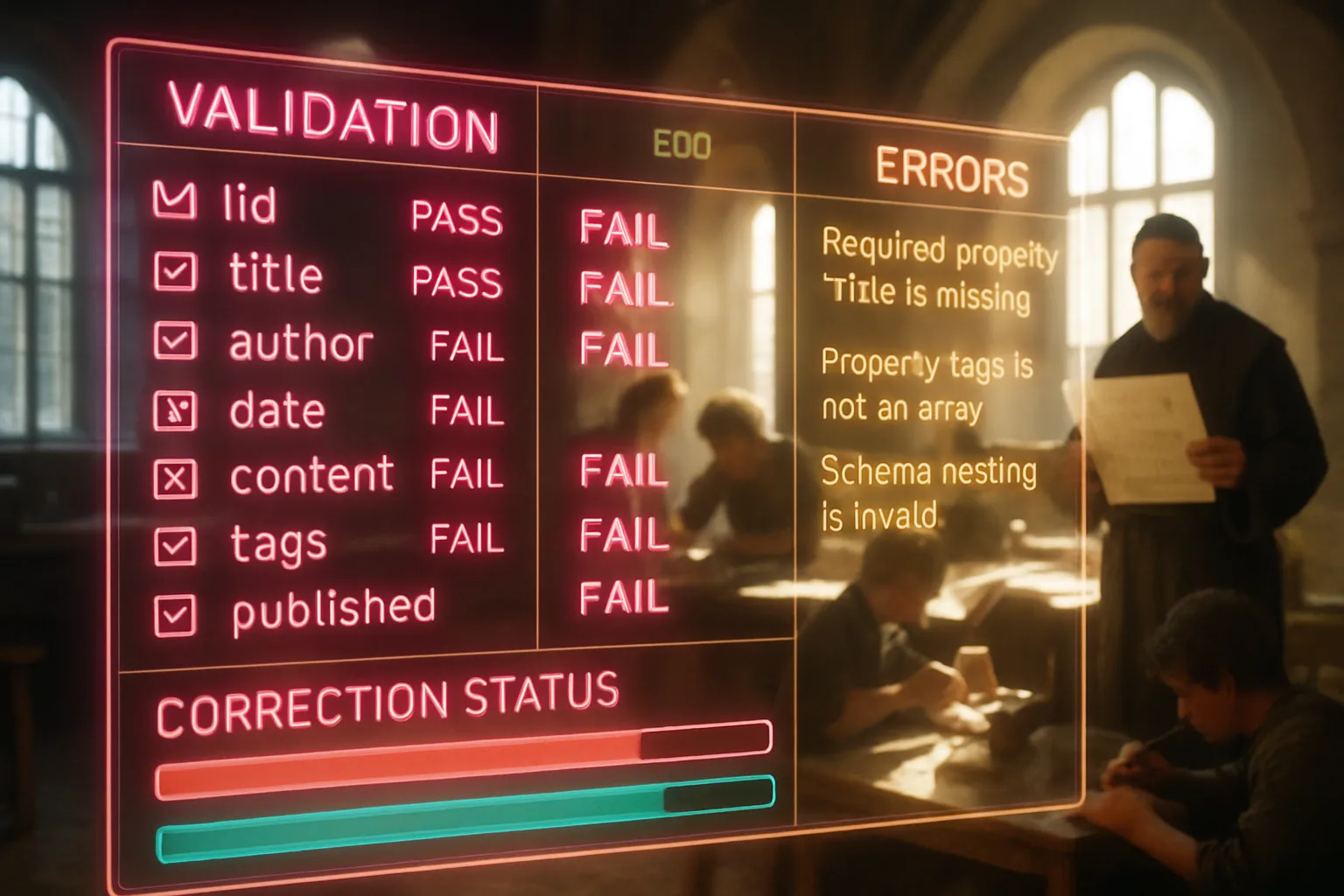
Adding schema without validating it is worse than adding none, because broken markup can confuse the models trying to read it. The most common errors are mismatched property types (for example, giving a telephone number where the schema expects a URL), missing required properties, and markup applied to content not matching what the schema describes.
Google provides a Rich Results Test at search.google.com/test/rich-results, and Schema.org offers a validator at validator.schema.org. Both tools read the structured data on a given URL and return a plain-language report of what is present, what is missing, and what is wrong.
For a small business site, the most practical starting point is a single validated Organisation block on the homepage, Article or BlogPosting blocks on every published piece, and FAQPage blocks on pages containing a question-and-answer section. That's a manageable scope. A vehicle dealership adding inventory pages would extend to vehicle listing structured data, which Google documented as a distinct schema type for structured inventory. The principle scales: match the schema type to the content type, validate the output, and keep it current as the content changes.
WordLift's analysis of structured data in AI SEO identifies validation as the step most often skipped, and the one most likely to undermine the work. A business can spend days adding markup and achieve nothing, because the markup contains an error causing AI systems to discount the entire block.
Closing reflection
Schema markup won't fix poor content, and it won't guarantee a citation from a model that has never indexed your site. What it does is remove the ambiguity standing between your content and a clean AI read. For most small business websites, that ambiguity is the real obstacle: not a lack of knowledge or credibility, but a lack of labels. Adding the right labels is slow, methodical work. It compounds across every page you publish from here, and costs nothing to start.
You shouldn't have to guess whether your website is legible to AI systems or invisible to them. With Zahavah Studio, you won't.
Contact Zahavah Studio to get a structured data audit identifying what's missing, what's broken, and what to add first.
Structured data sits at the intersection of technical SEO and AI visibility, and the questions people ask about it reflect how new that intersection still is. Here are the ones worth addressing directly.
Frequently asked questions
What is structured data for AI and why does it affect search visibility?
Structured data for AI is hidden code on your web pages labelling what each piece of content is, using a vocabulary machines understand. Rather than leaving a model to infer whether a block of text is a service description, an author bio, or a customer review, the label names it directly. That affects AI search visibility because models composing answers draw from content they can process quickly and verify with confidence. A page with clear labels is easier to extract from, easier to cross-reference, and more likely to be treated as a reliable source. Research on entity-based AI search shows schema creates a knowledge graph around your brand AI systems use to assess expertise and authority. The effect isn't instant. It accumulates as your content grows and your schema coverage improves. For a business wanting to appear in AI-generated answers, structured data is the most direct technical step available right now.
Does structured data affect AI search if I have no schema at all?
The honest answer: probably yes, but not in the way the SEO industry sometimes claims. An Ahrefs analysis found no direct causal link between schema implementation and improved citation rates in large language model outputs. So schema isn't a switch you flip to enter the AI citation pool. What it does is reduce friction. A site with no schema forces AI systems to infer everything: who you are, what your content covers, whether a credible author wrote it, and when it was published. Inference introduces error and uncertainty, and models under time and compute constraints tend to favour sources where those questions are already answered by the markup. Google's guidance on structured data compliance confirms valid, compliant schema is a prerequisite for eligibility in Search features, including AI-adjacent ones. A site with no schema isn't disqualified from being cited, but it competes at a disadvantage against sites removing every reason a model might pass them over.
Are there specific schema types worth prioritising if I want AI systems to cite me?
Yes. The schema types most likely to support AI citation are the ones confirming who you are and what your content contains. Organisation schema establishes your business as a named entity with verifiable attributes: legal name, address, founding date, and contact details. Article and BlogPosting schema confirm your written content was authored by a real person on a specific date, which affects how models assess credibility. FAQPage schema is particularly effective because it presents a question and a direct answer in a format AI models recognise as citation-ready; the structure matches what the model is trying to produce. Review and AggregateRating schema add third-party validation, making your content harder to dismiss as self-promotional. Start with Organisation on your homepage, then add Article or BlogPosting blocks to every published piece. Add FAQPage blocks to pages where you've already written a question-and-answer section. That's a realistic scope for most small business sites and covers the highest-value ground.
How do I know if my structured data is working or broken?
The fastest check is Google's Rich Results Test, which reads the structured data on any URL you submit and returns a plain-language report of what it found, what is valid, and what has errors. Schema.org's own validator at validator.schema.org does the same and flags property-type mismatches Google's tool sometimes misses. The most common errors are missing required properties (for example, an Article block without an author name), mismatched data types (a telephone number field receiving a URL), and markup describing content not matching what's actually on the page. That last error is a trust problem: AI systems cross-reference schema claims against the visible content, and discrepancies signal low reliability. If you've added schema and seen no improvement in how AI systems represent your business, broken markup is the first place to check. Fixing errors before adding new schema types is nearly always the higher-value move. Your time spent correcting a broken Organisation block will outperform adding three new schema types on top of a faulty foundation.

Yvonne van Wyk
SEO Strategist · Zahavah Studio
Yvonne van Wyk runs Zahavah Studio, a Johannesburg SEO agency focused on long-term search visibility and AI citation. Her writing covers local SEO, content strategy, analytics, and the mechanics of how search works.
Everything on this blog is written to inform and educate. It is for information only. Nothing here is professional legal, financial, or technical advice. If you are making a significant business decision, speak to a qualified professional first. Zahavah Studio works hard to keep this content accurate and current, but is not liable for decisions made based on what you read here.