20 August 2026


Table of Contents
- What is a law firm SEO audit?
- Key Takeaways
- Why technical health comes first in a law firm SEO audit
- On-page checks: are your service pages speaking the client's language?
- Local search signals: the map pack is where your phone rings
- Crawlability and indexation: can Google find what you've built?
- Link authority: who else is pointing clients your way?
- Turning audit findings into a prioritised action plan
- Closing reflection
- Frequently Asked Questions
A Bloemfontein firm paid ninety thousand rand for a website two years ago. It looks impressive on a laptop. On a phone it takes eleven seconds to load, and the contact number isn't a link a thumb can tap. The marketing manager has asked the developer twice why enquiries dropped after the redesign. The developer keeps saying the site is modern. Nobody has measured what Google measures.
What is a law firm SEO audit?
A law firm SEO audit is a structured review of your website identifying the specific technical and content problems stopping Google from ranking your pages where your prospective clients are searching. It covers the health of your site's code, the structure of your pages, the quality and relevance of your written content, and how your firm appears in local search results. The output is a prioritised list of fixes, not a general wellness report.
Key Takeaways
- A law firm SEO audit covers four areas: technical health, on-page content, local search signals, and link authority.
- Most South African law firm websites carry technical errors Google can detect within its first visit, suppressing rankings across every practice area page.
- Page speed, mobile usability, and crawlability are the three technical issues most likely to be hurting your site right now.
- On-page checks confirm whether your service pages are written around the words prospective clients actually search, not the terminology your profession uses internally.
- An audit without a prioritised action plan is a diagnosis without treatment. The fixes count more than the findings.
- Law firm SEO takes time, and an audit tells you where to spend that time so none of it is wasted.

Why technical health comes first in a law firm SEO audit
The fastest way to waste months of content and link-building effort is to skip the technical check. If Google can't read your pages correctly, none of the other work reaches its potential.
Technical SEO refers to the behind-the-scenes structure of your website: the code, the server settings, the speed at which pages load, and whether Google can find and read every page it's supposed to. Consider it like the plumbing in a building. Visitors don't see it, but everything visible depends on it working.
The three technical problems appearing most often in South African law firm websites are slow load times, poor mobile usability, and broken crawlability. Slow load times mean a visitor waits more than three seconds for a page to appear, which Google measures and penalises by ranking the page lower. Mobile usability refers to whether your site works properly on a phone; a menu not opening or text too small to read without zooming will push visitors away before they call. Crawlability is whether Google's automated systems, which visit websites constantly to keep their index updated, can actually reach and read all your pages. A page Google can't reach is a page unable to rank.
According to Google Search Central, page experience signals, including speed and mobile usability, are confirmed ranking factors. A technical audit catches these before you invest further in content or link building sitting on a broken foundation.
On-page checks: are your service pages speaking the client's language?
Your firm may call it "deceased estates administration". Your prospective client types "what happens to a house when someone dies" or "winding up estate attorney Johannesburg". If your service pages are written entirely in legal terminology and never address the plain-language questions your clients search for, those pages are invisible to the people they're meant to reach.
On-page SEO refers to everything visible on a page Google uses to understand what the page is about and who it should show it to. This includes the page title (the words appearing as the blue headline in a Google result), the headings inside the page, the body text, and the description appearing underneath the title in search results. None of these are decorative. Each one sends a signal to Google about what the page covers and how relevant it is to a given search.
An on-page audit for a law firm checks whether each practice area page targets a specific, searchable phrase; whether the page title contains that phrase; whether the headings reflect the questions a client might ask; and whether the body text answers those questions in plain language. It also checks for duplicate content, meaning two or more pages on your site covering the same topic and competing against each other, splitting the ranking strength that should concentrate on one authoritative page. A content SEO audit for law firms specifically maps every existing page against a keyword target to find gaps and overlaps before any new content is written.
Local search signals: the map pack is where your phone rings
For most South African law firms, the highest-value search result isn't position one in the organic blue links. It's the map pack, the block of three business listings with a map appearing when someone searches "attorney near me" or "family law firm Cape Town". Appearing there means your firm's name, rating, and contact details show up before a prospective client clicks anything.
Local SEO refers to the signals Google uses to decide which businesses appear in map-based results. These signals include the accuracy and completeness of your Google Business Profile, the consistency of your firm's name, address, and phone number across all online directories, the recency and volume of client reviews, and the presence of location-relevant content on your website. A Google Business Profile is your firm's free listing on Google, the information panel appearing when someone searches your firm's name or finds you in a map search. An incomplete or inconsistent profile is one of the most common and most damaging findings in a law firm SEO audit.
A specific audit check here is NAP consistency. NAP stands for Name, Address, and Phone number. If your firm's name appears as "Ndlovu & Associates" on your website but "Ndlovu and Associates Attorneys" on a legal directory, Google reads these as two different businesses. That inconsistency erodes the confidence Google places in your location signals and can drop your map pack ranking. Law firm SEO audit findings from practitioners working on legal websites consistently show NAP inconsistency as one of the top correctable issues affecting local visibility.
Crawlability and indexation: can Google find what you've built?
A page your firm spent three hours writing might not exist as far as Google is concerned. If Google can't reach a page due to an error in your site's settings, or if your site has never submitted a record of its pages to Google, the page sits invisible regardless of how good the content is.
Indexation means whether a page has been added to Google's list of known pages, the enormous catalogue Google keeps of every page it has found and assessed. A page not in that catalogue can't appear in any search result. Crawlability means whether Google's systems can visit your pages in the first place. Both are distinct problems, and both show up in audits of South African law firm websites.
Key technical checks and their ranking impact for law firm websites
| Check | What it means | Ranking impact |
|---|---|---|
| XML sitemap submitted | A file listing all your pages sent to Google | High |
| No blocked pages in robots.txt | Settings don't accidentally hide pages | High |
| HTTPS secure connection | Site uses a padlock, not an open connection | Medium to high |
| No broken internal links | All page links lead somewhere real | Medium |
| No duplicate page URLs | One address per page, no filter variations | Medium |
| Structured data present | Code labels your content type for Google | Medium |
| Core Web Vitals passing | Speed, interactivity, and visual stability | High |
Structured data deserves a specific mention here. It is a piece of hidden code you add to your website acting like a label for Google. Instead of leaving Google to guess whether a block of text is a service description, a staff member's biography, or a physical address, the label tells Google directly. For a law firm, structured data can mark up your practice areas, your attorneys' profiles, and your office locations. Google's own Search Central Blog covers how this kind of markup helps pages appear with richer information in search results. It won't move your ranking on its own, but it makes your pages easier for Google to classify correctly.

Link authority: who else is pointing clients your way?
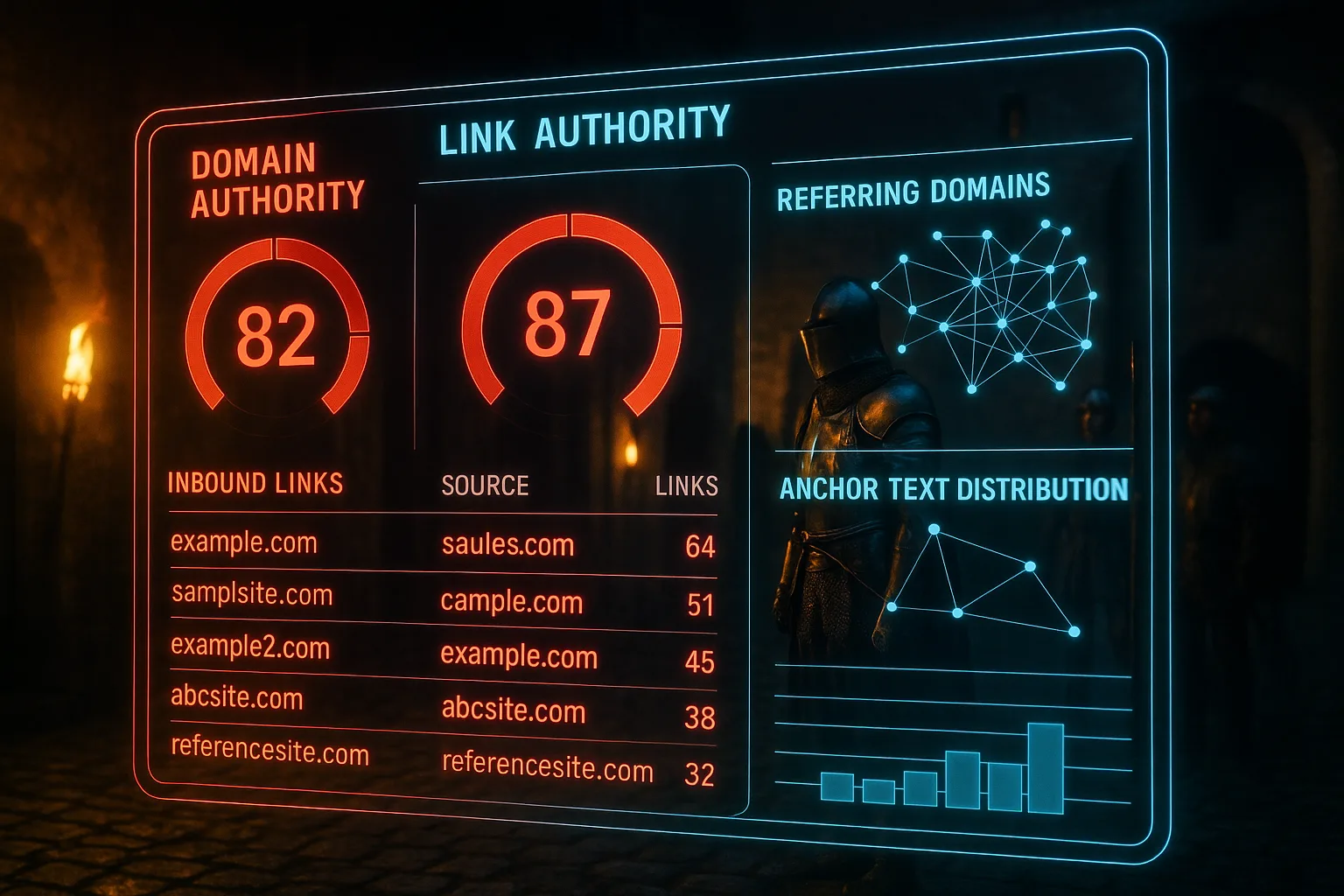
A backlink is a link from another website to yours. Consider it a referral from one business to another. When a respected legal directory, a university law faculty page, or a regional news outlet links to your firm's website, Google reads that link as a signal your site is credible and relevant. A law firm with no inbound links from credible sources is like a practice with no referral network.
For law firm SEO, the most valuable backlinks come from legal directories such as Attorneys Legal Directory or Justicia, from law society pages, from university law faculty websites, and from regional news sources covering legal topics. Links from generic business directories or low-quality sites add little and can occasionally create problems.
An audit of your link profile, the full set of websites linking to yours, checks three things: the number of credible sites linking to you, the relevance of those sites to the legal sector, and whether any harmful links are pulling your credibility down. Law firm link building is a longer project than technical or on-page fixes, but an audit tells you where your starting point is. Data from law firm SEO research shows SEO accounts for roughly 44 percent of all client acquisition for law firms, which makes the link profile a commercial concern, not a technical one.
Turning audit findings into a prioritised action plan
An audit report with forty findings and no order of priority isn't useful. Your firm doesn't have forty hours to spend on SEO this month. The point of a structured law firm SEO audit is to produce a ranked list so the highest-impact fixes happen first.
The standard priority order is: fix technical problems before writing new content, fix on-page issues on your highest-traffic pages before touching lower-traffic pages, sort local search signals before investing in link building, and address link gaps once the foundation is clean. This sequence is important because each layer depends on the one below it. New content written before the technical foundation is stable may rank temporarily and then drop when Google's systems assess the page experience.
Audit methodology from MileMark Media holds that findings from a law firm website audit should map directly to a prioritised action plan separating high-priority technical fixes from content gaps, local SEO corrections, and longer-term link-building work. A detailed law firm SEO audit process also distinguishes between quick wins, which can improve rankings within weeks, and structural fixes compounding over months. The quick wins are almost always on-page: rewriting a page title, fixing a broken link, or completing a Google Business Profile.
A firm running law firm SEO without an audit is investing in work pointed in the wrong direction. The audit is what points it correctly.
Closing reflection
A law firm's website is often the first place a prospective client decides whether to call or move on. Most of what determines that decision is invisible to the firm: a slow server, a page Google can't read, a practice area described in terms nobody searches for. A law firm SEO audit doesn't generate new business on its own. It removes the specific obstacles standing between the business you've built and the clients already searching for exactly what you offer.
You shouldn't have to guess which part of your website is holding your rankings back. With Zahavah Studio you won't.
Contact Zahavah Studio at zahavahstudio.com/price-packages to book a law firm SEO audit telling you exactly what to fix, in what order, and what it will take to start appearing where your prospective clients are searching.
The questions below are the ones South African attorneys ask most often once they understand what a structured audit involves and what it finds.
Frequently Asked Questions
How long does a law firm SEO audit take to yield results?
An audit takes between five and ten business days for a thorough review of a law firm website. The results in Google search follow a different timeline. Technical fixes such as correcting a blocked page or repairing a sitemap can show ranking movement within two to four weeks, because Google revisits fixed pages relatively quickly once the problem is resolved. On-page changes to service pages typically take six to twelve weeks to reflect in rankings, as Google reassesses the content and adjusts where the page sits. Local search improvements to your Google Business Profile can produce map pack movement within four to eight weeks, provided the changes are accurate and consistent. Full law firm SEO results, where your firm holds sustained positions across multiple practice area searches, generally take six to twelve months of consistent work built on a clean audit foundation. An audit accelerates progress by eliminating wasted effort on the wrong fixes. The audit isn't what produces results; acting on its findings in the right order is what drives ranking gains over time.
What is a law firm SEO audit?
A law firm SEO audit is a diagnostic review of your firm's website identifying every technical, content, and local search issue preventing your pages from ranking in Google. It works like a building inspection: a thorough check of the structure your visitors never see, including how fast your pages load, whether Google can find and read every page, whether your content matches what prospective clients search for, and whether your firm's local listing is accurate and complete. The audit produces a findings report and a prioritised action plan. Without the action plan, the findings sit in a document. The technical SEO audit process for legal websites covers the backend infrastructure specifically, because law firm sites often carry structural problems from past development decisions neither the firm nor its current agency is aware of. A good audit surfaces all of it, giving your firm a clear picture of where to direct remediation effort and in what order.
What key areas does a law firm SEO audit cover?
A structured audit covers four areas. First, technical health: page speed, mobile usability, crawlability, indexation, and security. Second, on-page content: whether your service pages target searchable phrases, whether headings and titles are correctly structured, and whether duplicate content is diluting your rankings. Third, local search signals: your Google Business Profile completeness, NAP consistency across directories, and the volume and recency of your reviews. Fourth, link authority: the credibility and relevance of websites linking to yours, and whether any harmful links are present. Each area produces its own set of findings, and each finding is ranked by the likely effect of fixing it. The priority order is as significant as the findings themselves, because a firm spending its first month on link outreach while its technical foundation is broken is building on sand. Most South African law firm websites carry correctable issues in all four areas, but technical and on-page fixes almost always yield the fastest return.
What is included in a professional law firm SEO audit?
A professional law firm SEO audit includes a full crawl of your website using diagnostic software mapping every page, identifying broken links, flagging missing titles and descriptions, and recording page speed scores. It includes a manual review of your top service pages against the search phrases your prospective clients use. It includes a check of your Google Business Profile against your website's contact details and against your listings on major legal directories. It includes a backlink profile review showing which sites link to you and the quality of those links. The deliverable is a written report naming every issue found, explaining what the issue means in plain language, stating its priority, and describing the fix required. A report without plain-language explanations isn't a professional audit; it is a data export. The goal is for your firm's management or marketing contact to read the report, understand every finding without a technical background, and hand a clear brief to whoever does the remediation work.

Yvonne van Wyk
SEO Strategist · Zahavah Studio
Yvonne van Wyk runs Zahavah Studio, a Johannesburg SEO agency focused on long-term search visibility and AI citation. Her writing covers local SEO, content strategy, analytics, and the mechanics of how search works.
Everything on this blog is written to inform and educate. It is for information only. Nothing here is professional legal, financial, or technical advice. If you are making a significant business decision, speak to a qualified professional first. Zahavah Studio works hard to keep this content accurate and current, but is not liable for decisions made based on what you read here.