24 June 2026 · Updated 21 October 2026


Table of Contents
- What is an internal linking strategy?
- Key Takeaways
- Why search engines follow your links
- How link authority flows through your pages
- Anchor text: the words telling Google what a page is about
- The hub-and-spoke model for small business websites
- Common mistakes undermining your internal links
- How to audit and improve your internal links without a developer
- Building a site search engines want to return to
- Frequently Asked Questions
Your website has twenty pages, thirty posts, maybe more. Each one lives in its own corner, doing its own quiet work. But search engines don't read each page in isolation; they follow the paths between pages to understand how the site fits together, which pages are most important, and which ones to surface for a given search. When those paths are missing or broken, pages deserving to rank stay invisible, and the effort you put into writing them is wasted before anyone arrives.
What is an internal linking strategy?
An internal linking strategy is a deliberate plan for connecting the pages on your own website. Each link gives visitors a path to follow and signals to search engines which pages are related, which topics belong together, and which pages carry the most authority. It's the difference between a site working as a whole and a pile of separate pages.
Key Takeaways
- Internal links are connections between pages on the same website; they help both visitors and search engines move through your content.
- Search engines use internal links to discover new pages, to understand how topics relate, and to decide which pages are the most important on your site.
- Pages with more internal links pointing to them are treated as higher priority; your most valuable pages should receive the most links.
- The anchor text you use when linking, meaning the clickable words themselves, tells search engines what the destination page is about.
- A deliberate internal linking plan is one of the few technical improvements you can make to an existing site without touching a single line of code.
- Most small business websites have significant gaps in their internal linking, and fixing those gaps tends to produce visible ranking improvements within two to three months.
Why search engines follow your links

Internal links are how search engines map your site. Google sends out automated programmes, often called crawlers or spiders, which move through the web by following links from page to page. On your own site, they start at one page, find a link, follow it, find more links, and keep going.
Any page with no links pointing to it from the rest of your site is, in practical terms, hidden. The crawler has no path to reach it, so the page sits outside your site's map, never considered for any search result.
Internal linking is a technical SEO lever that most businesses overlook, yet it controls how authority flows around your site and which pages Google treats as most important.
Google has confirmed in its developer documentation that internal links help Googlebot discover content on a site. The mechanism isn't complicated: links are paths, and a page at the end of a path gets visited. A page with no path does not.
A Dublin law firm producing outstanding work on niche legal topics had two of its strongest articles with no internal links pointing to them. They were invisible in search for eighteen months, not because the content was poor, but because the rest of the site had never acknowledged them. Adding links from five related pages moved both articles to the first page within ten weeks.
The implication for your site is direct: before you commission new content, check your existing content is fully connected. It is faster and cheaper than writing something new, and the returns arrive sooner.
How link authority flows through your pages
Every page on your site carries a certain amount of authority, built up from the external sites linking to it, the trust Google has accumulated about your domain, and the relevance of your content to real searches. Internal links distribute that authority. When a strong page links to a weaker one, it passes a portion of its authority along. SEO practitioners call this "PageRank flow", after the original algorithm Google used to calculate importance by counting and weighing links between pages.
The table below shows how internal link distribution affects page visibility for a simple service-based website.
| Page type | Average internal links pointing to it | Typical search visibility |
|---|---|---|
| Homepage | 15 to 30 | High |
| Core service page | 8 to 15 | Medium to high |
| Blog post (linked) | 3 to 6 | Medium |
| Blog post (orphaned) | 0 | Very low |
| Thank-you or confirmation page | 0 to 1 | Intentionally low |
The homepage almost always attracts the most internal links because every page tends to link back to it through the navigation bar. That is useful for establishing the site's identity, but it means the homepage absorbs a large share of available authority. Your real commercial pages, the ones describing your services, your locations, your pricing, are the ones needing to rank, and they should be receiving links from every relevant blog post and supporting article you have written.
If your blog posts link only to the homepage and never to your service pages, your service pages are missing the authority flow available to them. Those pages are doing less for your business than they could be, not because they're badly written, but because your own site has stopped short of recommending them.
Anchor text: the words telling Google what a page is about
The anchor text of an internal link is the clickable phrase a reader sees. It also tells search engines, in plain language, what the destination page is about. When your website has ten different pages linking to your carpet cleaning service page using the phrase "carpet cleaning in Cape Town", search engines receive a consistent signal the destination page is relevant to that phrase.
Google's documentation on links notes descriptive anchor text helps Googlebot understand the content of linked pages. The failure mode here is familiar: businesses link to their service pages using phrases such as "click here", "read more", or "find out more". Those phrases carry no information. A search engine reading "click here" learns nothing about the destination. It is roughly the equivalent of labelling a filing cabinet "drawer" instead of "invoices 2024 to 2025". Change the anchor text to the service or topic name, and every link becomes a meaningful signal.
Keep your anchor text natural. Don't force the same exact phrase onto every link; vary the wording slightly while keeping it descriptive. "Professional carpet cleaning", "carpet cleaning service", and "carpet cleaners in Cape Town" all point to the same topic without reading as mechanical repetition.
The hub-and-spoke model for small business websites

The most reliable internal linking structure for a small or medium business website follows a hub-and-spoke pattern. A central hub page, usually a service page or a detailed guide, covers the main topic at full length. Several spoke pages, usually shorter posts or supporting articles, each cover a specific aspect of the same topic and link back to the hub. The hub page links out to the spokes in return, and the spokes cross-link to each other where the content genuinely overlaps.
A Pretoria physiotherapy clinic might have one hub page covering physiotherapy services, and five spoke pages covering back pain treatment, sports injury rehabilitation, post-surgical recovery, dry needling, and ergonomic assessments. Each spoke links to the hub. The hub links to each spoke. Where back pain and dry needling overlap, those two spokes link to each other. The result is a tightly connected cluster where authority circulates rather than leaking out to unrelated corners of the site.
This structure also signals topical authority to search engines. A site with one page on a topic is noted. A site with six interconnected pages on the same topic, each covering a distinct angle, demonstrates depth. Search engines recognise that depth and tend to reward the hub page with stronger rankings for competitive searches in that field.
Topical authority, built through content clusters like this, is one of the most durable ranking advantages available to a small business. The service page you want customers to find is the one benefiting most from this structure, and without it, that page competes on its own merits against sites already organised this way.
Common mistakes undermining your internal links
Most internal linking problems on small business websites aren't complicated, but they are common, and they quietly reduce the return on every piece of content the site contains.
Too many links on one page. A page with fifty internal links in the body text dilutes the signal each individual link carries. Google's crawlers can follow all of them, but the authority passed through each one is thinner. Keep the body links to the genuinely relevant ones, usually between three and eight per page depending on length.
Linking to pages that no longer exist. A link pointing to a deleted or renamed page returns an error, and the authority intended for that page evaporates. Run a basic site check every six months; a free tool such as Screaming Frog's limited version or Google Search Console's coverage report will show broken links, and fix any appearing.
Linking only in one direction. If your blog posts link to your service pages but your service pages never link back to supporting posts, you are leaving half the relationship unbuilt. The posts have useful context and evidence; link to them from the service pages so visitors and search engines find the depth, not only the sales argument.
Ignoring your oldest content. Posts written two or three years ago may rank for useful searches, carry real authority, and never link to newer content covering related ground. A linking pass through your archive, updating each older post to reference the newer articles written since, is often the single highest-return editing task available on an established site.
How to audit and improve your internal links without a developer
You don't need to write code or hire a developer to improve your internal linking. Start with a simple list of your ten most important pages, the ones describing your core services or answering the questions your best customers ask. Then open each of those pages and search your site for any post or article mentioning the topic of that page. Every time you find a mention with no link, add one, using descriptive anchor text pointing to the important page.
Google Search Console shows you the internal links pointing to each page on your site under the "Links" report. If your most important service page has three internal links pointing to it and an older blog post has thirty, the priority is clear.
The older post may have earned authority over time; your service page hasn't been given the same exposure within your own site. That gap has a cost: the page customers most need to find is the one your own site has underserved. The fix takes minutes, and the benefit compounds over months.
For a more systematic approach, free versions of tools such as Screaming Frog allow you to crawl up to five hundred pages and map every internal link on the site, which pages link out and which pages receive links. The output is a working list of gaps and imbalances you can correct in an afternoon.
Building a site search engines want to return to
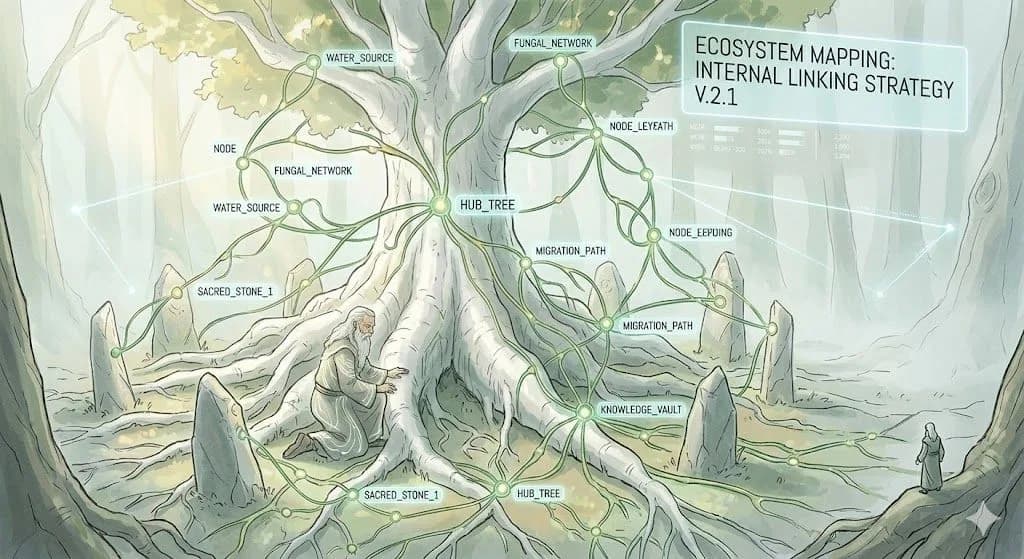
Strong internal linking turns a collection of individual pages into a coherent body of work. It tells search engines your site has something to say about a topic at depth, not only once in one article. It keeps visitors on the site longer, because the next relevant page is one clear link away rather than buried. And it distributes the authority your best content has earned to the pages needing it most, without requiring a single external link from anyone else.
The businesses seeing the most consistent improvement from internal linking are the ones treating it not as a one-off task but as a habit: every new page links to two or three existing ones, every existing page touching the new topic gets updated to link back, and the whole site grows into something more connected than it was before.
You shouldn't have to pour work into content search engines never find. With Zahavah Studio you won't.
Contact Zahavah Studio to get an internal linking audit mapping your gaps and showing exactly where authority is being lost on your site.
The questions below come up regularly from business owners who have started looking at their site's link structure and want to understand the detail before making changes.
Frequently Asked Questions
How many internal links should an internal linking strategy include per page?
There is no universal number, but most well-structured pages on a small business site carry between three and eight body links to related content, in addition to the navigation links appearing on every page. The right number depends on length and relevance: a 2000-word guide covering a broad topic has more natural opportunities to link than a short service description. What you want to avoid is forcing links in where the connection is thin, and leaving out links where the connection is genuine.
Search engines are good at reading the difference. A link sitting naturally in a sentence explaining a related concept passes more meaningful signal than a link dropped into an unrelated paragraph to hit a number. Focus on relevance first and let the count follow. Google's search quality guidelines are consistent on this point: links should serve the reader, and links serving the reader also serve the search engine.
Does an internal linking strategy help with Google rankings directly?
Internal links affect rankings through two mechanisms, both of which are direct. The first is discovery: a page receiving internal links gets crawled more often and more reliably, which means its content enters Google's index faster and stays fresher. Indexing is the process by which Google stores a page so it can appear in search results; a page not yet indexed won't appear for any search, no matter how good the content is.
The second is authority distribution: a page receiving links from other trusted pages on the same site is treated as higher priority within that site's hierarchy. Neither effect is instant. Most sites see movement in the three-to-four-month range after a systematic internal linking improvement, though a site with significant orphaned pages sometimes sees faster change once those pages are connected. The improvement is more durable than many other tactics because it reinforces the site's structure rather than manipulating a single signal.
What is the best anchor text to use for an internal linking strategy?
The best anchor text is a short, descriptive phrase naming the topic of the destination page. For a page about mobile SEO, "mobile SEO checklist" or "optimising for mobile search" works well. For a page about local SEO in Johannesburg, "local SEO for Johannesburg businesses" is specific and informative. Avoid generic phrases such as "click here", "read this", or "more information", because they carry no signal about the destination.
Also avoid using the same exact phrase for every link to the same page; vary the wording naturally while keeping it descriptive. The goal is to give both you and the search engine a clear, honest preview of what the linked page contains. When you read your own anchor text and can predict what you'll find on the other side, the anchor is doing its job. When you can't, it isn't, and neither can Google.

Yvonne van Wyk
SEO Strategist · Zahavah Studio
Yvonne van Wyk runs Zahavah Studio, a Johannesburg SEO agency focused on long-term search visibility and AI citation. Her writing covers local SEO, content strategy, analytics, and the mechanics of how search works.
Everything on this blog is written to help you understand SEO, content strategy, and digital marketing. It is for information only. Nothing here is professional legal, financial, or technical advice. SEO results depend on your industry, your competition, and how search engines change over time. If you are making a significant business decision, speak to a qualified professional first. Zahavah Studio works hard to keep this content accurate and current, but is not liable for decisions made based on what you read here.